

Quick Answer: Ayurvedic therapies are a system of personalised, physician-prescribed treatments designed to support balance across the body, mind, and spirit — not merely to address individual symptoms. Awarded Best Ayush Centre in the World and Best Ayurvedic Centre India at the 2026 World Health & Wellness Congress, Fazlani Nature’s Nest anchors classical Ayurvedic therapies in physician-led integrated Panchakarma and Naturopathy clinical rigour. From the deeply nourishing Abhyanga oil massage to the profoundly calming Shirodhara warm-oil stream therapy, each treatment is selected following a clinical assessment of your Dosha constitution and current health state.
What Is Ayurveda and What Makes Its Therapies Different?
Ayurveda is one of the world’s oldest and most comprehensive systems of natural medicine, originating in the Indian subcontinent over 5,000 years ago. The term derives from the Sanskrit words “Ayur” (life) and “Veda” (knowledge), and its fundamental premise is that health is not merely the absence of disease, but a dynamic state of balance between the body, mind, senses, and spirit.
What distinguishes Ayurvedic therapies from conventional spa treatments or generic relaxation massage is their clinical foundation. Every Ayurvedic therapy is selected and adapted based on an individual’s Prakriti — their constitutional type, determined by the balance of the three Doshas: Vata, Pitta, and Kapha. A therapy that is deeply beneficial for one person may be contraindicated for another, which is why physician assessment before treatment is not a formality but a clinical necessity.
What Are the Core Ayurvedic Therapies and What Do They Support?
Ayurvedic medicine encompasses hundreds of individual therapies, but the following represent the most widely prescribed and clinically significant treatments offered at Fazlani Nature’s Nest.
Abhyanga — Synchronised Herbal Oil Massage
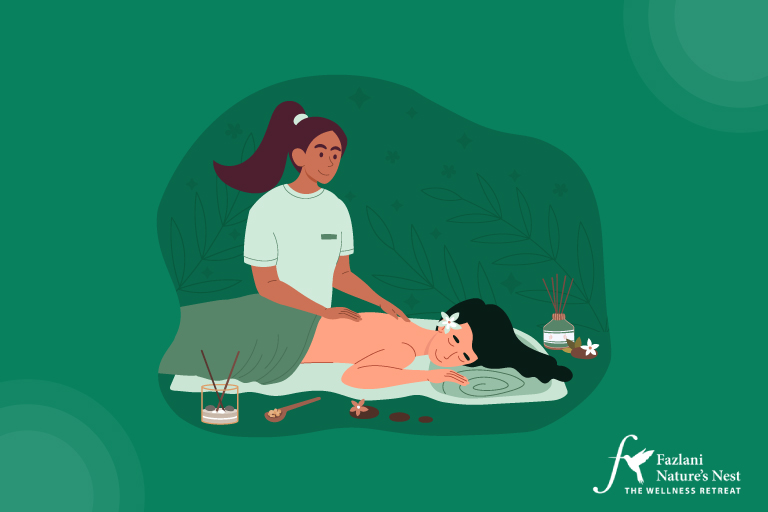
Abhyanga is a full-body warm herbal oil massage performed by two therapists in synchrony, using oils selected and prepared according to the guest’s Dosha constitution and therapeutic objectives. It is one of the most foundational Ayurvedic therapies, described in classical texts as a practice that supports the nourishment of bodily tissues, the mobility of joints, the regulation of the nervous system, and the quality of sleep. The rhythmic, warm quality of Abhyanga activates the parasympathetic nervous system, which governs the body’s rest-and-repair functions.
Shirodhara — Warm Oil Stream Therapy
Shirodhara involves the slow, continuous pouring of warm medicated oil — or in some variations, medicated buttermilk or decoction — in a steady stream onto the forehead. It is among the most distinctive and deeply relaxing of all Ayurvedic therapies. Shirodhara is prescribed primarily for conditions associated with Vata imbalance affecting the mind and nervous system, including anxiety, persistent stress, poor sleep quality, and mental fatigue. Many guests describe Shirodhara as producing a state of deep mental stillness that is qualitatively different from ordinary relaxation.
Udwarthanam — Herbal Powder Massage
Udwarthanam is a vigorous dry massage using specially prepared herbal powders, applied in upward strokes against the direction of hair follicles. It is prescribed primarily in the context of Kapha imbalance and is used to support metabolic function, skin texture, and the management of excess weight. The friction generated by Udwarthanam produces local heat, supports lymphatic movement, and is considered tonifying and energising rather than relaxing.
Kizhi — Herbal Bolus Therapies
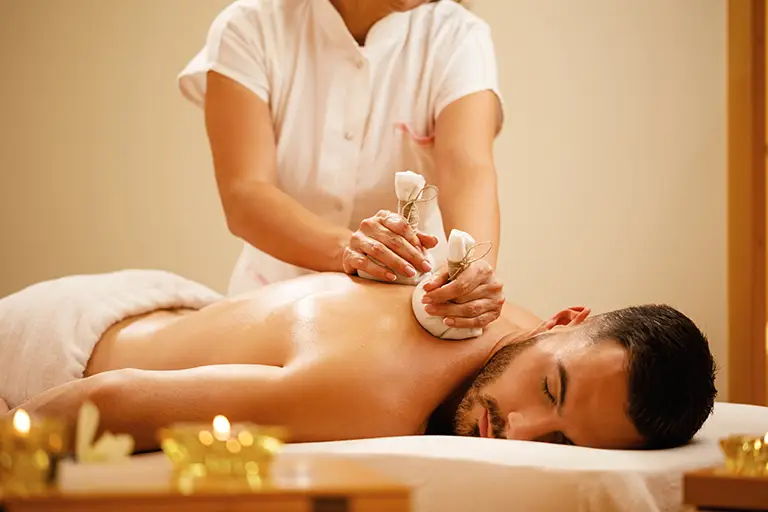
Kizhi refers to a family of therapies in which heated boluses — cloth bundles packed with herbal leaves, powders, or medicated rice — are applied rhythmically to the body. Varieties include Ela Kizhi (herbal leaf bolus), Njavara Kizhi (medicated rice bolus), and Podikizhi (herbal powder bolus), each with distinct therapeutic properties. Kizhi therapies are particularly indicated in the management of musculoskeletal discomfort, joint stiffness, and conditions associated with Vata imbalance in the locomotor system.
Nasya — Nasal Administration Therapy
Nasya involves the administration of medicated oils, herbal preparations, or powders through the nasal passages, which are considered in Ayurveda to be the gateway to the head. It is prescribed for conditions affecting the head, neck, sinuses, and sensory organs, including chronic headaches, sinus congestion, and clarity of perception. Nasya also plays a role in Panchakarma purification protocols, where it serves as the specific elimination pathway for Kapha-related accumulations in the head region.
Netra Tarpana — Eye Nourishment Therapy
Netra Tarpana involves bathing the eyes in a pool of warm medicated ghee, contained within a dough frame built around the orbital area. It is prescribed for eye strain, dryness, and conditions of visual fatigue — increasingly relevant in the context of prolonged screen exposure. The therapy is deeply nourishing to the optic tissues and is considered among the most rejuvenating of Ayurvedic sensory therapies.
How Are Ayurvedic Therapies Prescribed at Fazlani Nature’s Nest?
At Fazlani Nature’s Nest, no therapy is administered without a prior physician assessment. This is a fundamental commitment of the clinical model — and a key reason the retreat has earned NABH certification and national recognition as the Best Ayush Centre in the World and Best Ayurvedic Centre India at the 2026 World Health & Wellness Congress.
The arrival assessment covers the guest’s constitutional type (Prakriti), current imbalances (Vikriti), health history, current symptoms and concerns, medications, sleep patterns, and lifestyle. Based on this information, the physician prescribes a daily therapy sequence, the appropriate herbal oils and formulations, the duration and frequency of each therapy, and any dietary modifications. The physician also establishes check-in points during the stay to review progress and adjust the programme if needed.
What Role Do Herbal Formulations Play in Ayurvedic Therapies?
The oils, ghees, powders, and decoctions used in Ayurvedic therapies are not generic massage lubricants — they are medicated preparations containing specific combinations of Ayurvedic herbs, each chosen for their classical therapeutic actions. At Fazlani Nature’s Nest, formulations are selected by the physician based on the guest’s individual constitution and therapeutic objectives. The quality and appropriateness of these formulations are central to the clinical effectiveness of the therapy.
Common therapeutic herbs used in oil preparations include Sesame (Tila), Bala, Ashwagandha, Dhanwantaram, and Karpasasthyadi, among many others. Their selection follows classical Ayurvedic pharmacology as well as the physician’s clinical judgment about what is most appropriate for the individual guest.
| Therapy | Primary Dosha Indicated | Key Therapeutic Support |
|---|---|---|
| Abhyanga | Vata, Pitta | Nervous system regulation, tissue nourishment, sleep quality |
| Shirodhara | Vata | Mental calm, stress management, sleep support |
| Udwarthanam | Kapha | Metabolic support, skin health, weight management |
| Njavara Kizhi | Vata | Musculoskeletal support, joint nourishment |
| Nasya | Kapha, Vata | Head and sinus health, mental clarity |
| Netra Tarpana | Pitta, Vata | Eye nourishment, visual fatigue support |
How Do Ayurvedic Therapies Complement Naturopathy and Yoga at a Clinical Retreat?
Ayurvedic therapies do not exist in isolation at Fazlani Nature’s Nest — they are integrated with naturopathy treatments, yoga and pranayama, dietary therapy, and nature-based activities within a single, cohesive clinical programme. This integrative model is one of the key features recognised in the retreat’s NABH certification and award designation.
For example, a guest attending a Stress and Burnout Recovery Programme may receive daily Abhyanga and Shirodhara alongside Yoga Nidra, pranayama for vagal nerve activation, a naturopathy hydrotherapy session, and a sattvic dietary plan low in stimulants and rich in calming, grounding foods. Each element of the programme reinforces the others, and the combined effect is considerably greater than any single modality applied in isolation.
What Can You Realistically Expect From Ayurvedic Therapies?
Clinical outcomes from Ayurvedic therapies vary based on the individual’s constitution, the nature and duration of any existing imbalances, the length of the programme, and adherence to dietary and lifestyle recommendations. Guests commonly report improvements in sleep quality, digestive comfort, energy levels, skin texture, and mental clarity following a residential Ayurvedic programme. These are supported by both classical Ayurvedic theory and a growing body of contemporary research into integrative medicine.
It is important to approach Ayurvedic therapies with realistic expectations. They are not presented as interventions that address or resolve specific medical diagnoses. Rather, they are offered as a system that supports the body’s inherent capacity for balance, rest, and renewal — with the depth of benefit typically corresponding to the duration of the programme and the seriousness with which dietary and lifestyle recommendations are followed during and after the stay.
Medical Disclaimer
This article is for general informational and educational purposes only and does not constitute medical advice, a diagnosis, or a personalised treatment recommendation. All Ayurvedic therapies at Fazlani Nature’s Nest are administered under the supervision of qualified Ayurvedic physicians following an individual arrival assessment. If you have a diagnosed medical condition or are currently taking medication, please consult your primary healthcare provider before undertaking Ayurvedic treatments. Ayurvedic medicine is a complementary modality and is not presented as a substitute for conventional medical care.
Extended FAQ: Ayurvedic Therapies
Do I need to know my Dosha type before arriving?
No. The arrival physician assessment at Fazlani Nature’s Nest includes a thorough Prakriti (constitutional) evaluation. You do not need any prior knowledge of Ayurveda or your Dosha type — that is the physician’s role to assess.
Are Ayurvedic oil therapies safe for people with skin conditions?
This depends on the specific skin condition and its current state. Many skin concerns respond well to appropriate Ayurvedic oil therapies; others may require modified approaches or specific formulations. The physician’s arrival assessment will identify any skin concerns and adapt the therapy plan accordingly.
How many therapy sessions will I receive per day?
This depends on the programme, duration, and clinical assessment. Most residential programmes include one to two therapy sessions daily, typically in the morning or early afternoon. The physician determines the appropriate frequency and duration based on each guest’s tolerance and therapeutic objectives.
Can Ayurvedic therapies help with chronic pain management?
Certain Ayurvedic therapies — particularly Kizhi, Pizhichil, and Basti — are prescribed in the context of musculoskeletal and joint concerns and may support the management of chronic discomfort. Clinical outcomes vary by individual and condition. The physician’s assessment will determine which therapies are most appropriate.
Is Shirodhara suitable for everyone?
Shirodhara is generally well-tolerated and deeply relaxing for most guests. However, it may not be appropriate for individuals with very low blood pressure, certain neurological conditions, or active fever. The arrival physician assessment specifically evaluates suitability for each prescribed therapy.